


The Fed Chair Just Said AI Has ‘Huge Implications’ for Rates. Investors Should Listen
The Fed Chair Just Said AI Has ‘Huge Implications’ for Rates. Investors Should Listen
Omor Ibne EhsanThu, July 2, 2026 at 12:19 AM UTC
0
24/7 Wall St.Quick Read -
Warsh tied the entire future of interest rates to whether the AI capex wave delivers real productivity gains, reshaping monetary policy either way.
Q1 2026 private investment surged 7.9% while consumer spending crawled at 0.5%, showing that capex rather than consumers is driving growth.
Core PCE hitting a 12-month high and flat real wages signal AI productivity hasn't arrived yet, making July's FOMC decision pivotal.
Don't wait: the analyst who called NVIDIA in 2010 just revealed his top 10 AI stocks. See the full list FREE now.
Kevin Warsh went to Sintra and did something Fed chairs rarely do. He tied the entire future of interest rates to whether the AI capex wave actually delivers on its promises. That is a big deal for anyone holding stocks priced for a productivity miracle.
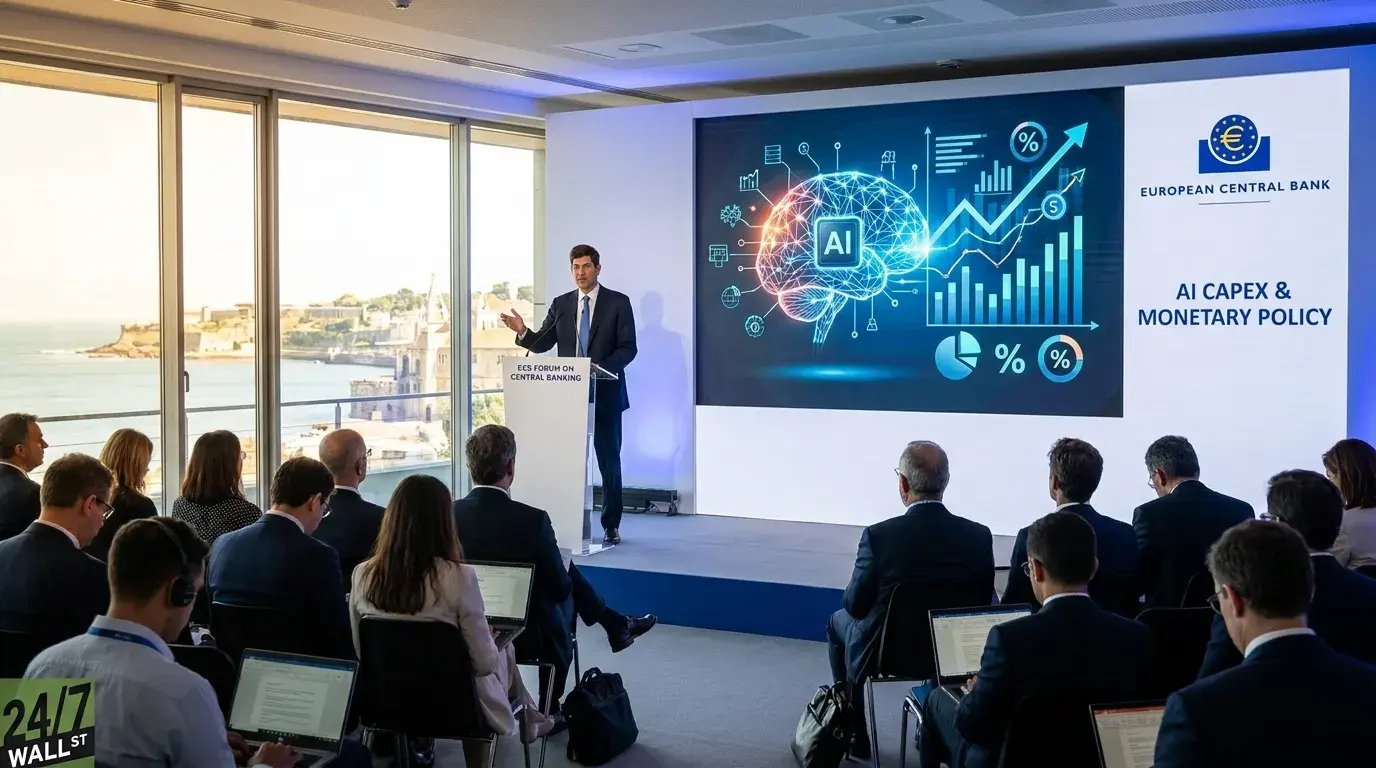
Speaking at the ECB Forum on Central Banking in Portugal, the Fed Chairman argued that the AI shock is showing up first and most prominently in the United States, and that the way it plays out will reshape monetary policy in ways markets are still pricing in. "The AI shock is leading to a boom in capital expenditures. We see that first and foremost in demand, but I'm confident we're going to see it in supply at some point," Warsh said.
Why a Fed Chair is suddenly talking like a tech analyst
Warsh's framing matters because it reframes the AI boom as a supply-side story, one that expands productive capacity rather than forcing the Fed into rate hikes. Companies pouring cash into data centers, chips, and power infrastructure are, in his read, betting that the productive capacity of the economy is about to expand. "Right now they're investing in the future because their expectation is the supply side of the economy will expand. And if it does, that has huge implications for monetary policy," he said.
Don't wait: the analyst who called NVIDIA in 2010 just revealed his top 10 AI stocks. See the full list FREE now.
That is different from the last cycle. Warsh drew a contrast with an earlier era dominated by financial engineering and buybacks, saying "I'd certainly rather have this problem where we have massive capital expenditures." The Fed is watching whether corporate America is actually building something, not just tracking the data flow.
You can see that shift in the profits mix. Domestic nonfinancial corporate profits hit $2,971.1 billion in the first quarter, and the information sector alone printed $352.5 billion, up from $265 billion two years earlier. Durable goods manufacturing profits jumped to $452.9 billion. Those are the numbers that show up when factories run hot building the picks and shovels of an AI buildout.
What the data actually shows so far
The 2026 Q1 GDP report backs the story up in a strange way. Headline growth came in at 2.1%, with gross private investment ripping at 7.9% while personal consumption crawled at just 0.5%. Growth is coming from capex while the consumer sits out, exactly the picture Warsh described.
Advertisement
Now the supply-side part. Real average hourly earnings sat at 11.24 in May, essentially unchanged from 11.24 in December 2024. If AI is boosting productivity, workers have not yet felt it in their paychecks. And Core PCE, the Fed's favorite inflation gauge, keeps grinding higher, hitting 130.08 in May, its highest reading in the 12-month window and in the 90.9th percentile of recent history. The disinflation story is not obvious yet.
What it means for your portfolio
The Fed has held the funds rate at 3.75% for seven months after 75 basis points of cuts over the past year. Bonds have noticed. The 10-year yield sits at 4.38%, and the 10Y-2Y spread has compressed to 0.30% from a February peak of 0.74%. A flattening curve says the market is unsure whether growth accelerates or fades.
Warsh's message threads that needle. If AI capex translates into real productivity, the Fed gets room to cut without reigniting inflation, and long-duration growth stocks get the disinflationary tailwind they have been priced for.
If the supply-side payoff is slow or never arrives, the same capex boom is just extra demand chasing constrained inputs, and rates stay higher for longer. You can read Warsh's full remarks on the Federal Reserve's speeches page.
"We're spending most of our time trying to monitor those developments," Warsh said. He added that the Fed will reassess in about four weeks. Which puts the next FOMC meeting squarely at the center of the AI trade. Keep an eye on the July decision. This one is not routine.
Don't wait: the analyst who called NVIDIA in 2010 just revealed his top 10 AI stocks. See the full list FREE now.
Contact editorial@247wallst.com for any questions or corrections.
Source: “AOL Money”
